

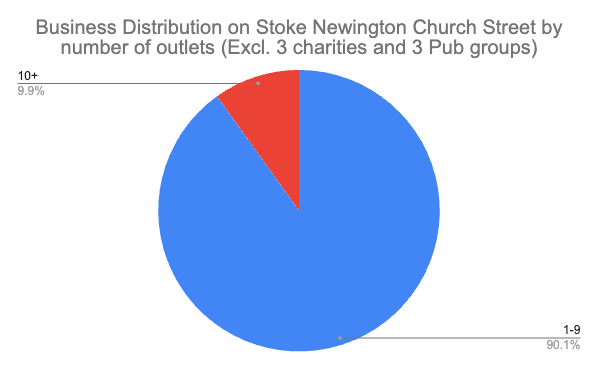
As part of my ongoing exploration of local businesses on Stoke Newington Church Street, I conducted an analysis of the number of outlets operated by each business, aiming to understand the split between independents and chains in the street. The key finding is that only 10% of businesses on Church Street are chains. This is based on the working definition of a chain as a business that operates 10 or more outlets, all with unified branding.
Many local businesses, such as Meat N16, Spence Bakery, Shine, The Good Egg, Made in Little France, De Nadas, Pachara, and Blue Legume—each with 2-3 outlets—fit more closely with the definition of growing independent businesses. As a result, only 10% of businesses on Church Street can be classified as chains (e.g., Winkworth Estate Agent and Jimmy Fairly Opticians). In contrast, 90% of businesses are independent, with nearly 70% operating a single location.
The Scope of the Analysis
The overall analysis includes a variety of entities along Church Street:
- Businesses (including retail, eateries, and services)
- Charities
- Pub companies
To give a clearer sense of the local business landscape, I’ve compiled the distribution of these entities by the number of outlets they operate. The table below offers insights into the variety of businesses on the street, ranging from small, independent shops to larger organisations with multiple locations.
Important Distinctions
While the analysis does not explicitly differentiate between small and large chains, a few distinctions are worth considering:
- Independent Businesses: A small business with two branches might not be seen as a chain, but rather as a growing independent business. These businesses typically retain a more local feel while expanding.
- Larger Chains: A company with 10 or more branches, uniform branding, and centralised systems is more likely to be recognised as a chain. These businesses have the infrastructure and scale to operate beyond the local level.
- Small Pub Groups: Small pub groups, such as those that own the Red Lion (owned by Frontier Pubs, which operates 15 pubs), the Rose and Crown (owned by London Village Inns, which operates 7 pubs), and the Clarence Tavern (owned by Natural Pubs Limited, which operates 4 pubs), manage a handful of locations without uniform branding, shared menus, or standardised operations. Each establishment maintains its own unique identity. These entities are more accurately defined as independent operators, as opposed to chains, which are typically characterised by larger companies like Greene King or Punch Taverns that have uniform branding, menus, and centralised systems across all their outlets.
- Charity Organisations: Charity organisations, such as those operating on Stoke Newington Church Street (Mind, Children’s Air Ambulance, and Mary’s Living & Giving), may need to be excluded if the aim of the analysis is to focus solely on retail, restaurant, and service businesses. Their inclusion could skew the perception of business distribution if the focus is specifically on commercial operations.
This analysis refers to ‘entities’ rather than explicitly to ‘chains,’ as it encompasses a wide range of operations, from small local businesses to larger, more centralised organisations, including charities and pub companies. Additionally, the analysis includes a separate view of the data when excluding the charities and pub groups to focus more specifically on retail, restaurant, and service businesses.
A Snapshot of Business Distribution

Here’s a breakdown of the distribution of 111 businesses and entities currently operating in Stoke Newington Church Street:
- 67% of businesses (72 businesses) are independent, with only one outlet each.
- 14% of businesses (15 businesses) have between 2-4 outlets, often representing independent businesses that have grown into small chains (For example: The Blue Legume, De Nadas, Made in Little France, Pachara, Meat N16, Acoustic Brasserie, The Spence Bakery),
- 6% of businesses (6 businesses) have between 5-9 outlets (For example: Safedale Chemists, The Tiffin Tin Indian takeaway, Odonno’s Ice cream shop).
- 7% of businesses (7 businesses) have between 10-50 outlets (For example: Foxtons Estate Agents, Ollie Quinn, Felicity J. Lord Estate Agents).
- 3% of businesses (3 businesses) have between 51-99 outlets (Winkworth Estate agent, Jimmy Fairly Opticians, Children’s Air Ambulance Charity Shop)
- 4% of businesses (4 businesses) have 100 or more outlets (Nando’s, Wholefoods, Mind Charity Shop, Gail’s Bakery).
It’s interesting to note that four businesses on Church Street with more than one location have expanded within the street itself. Evergreen & Outrageous operates Plantastic, a plant shop next door. Acoustic Brasserie took over N16 Flowers and transformed it into The Acoustic Stokey Garden. Church Street Food & Wine acquired the former Clissold Wines, located just two doors away. Additionally, Array opened a second shop, situated two doors from its original location.
Entities with at Least 10 Outlets

For the purpose of this analysis, a “chain” is defined as an entity that operates 10 or more outlets, with uniform branding and centralised systems. These businesses typically have the infrastructure and scale to extend beyond local operations, offering consistent branding, customer experience, and operational processes across locations. The initial view of entities with at least 10 outlets includes all entities, including charities and pubs operated by pub groups, which may not fully align with the typical characteristics of a chain.
Entities operating fewer than 10 outlets are often better considered as growing independent businesses rather than chains. For example, businesses like Meat N16, De Nadas, Pachara, The Blue Legume, and Made in Little France on Church Street, each with three branches, maintain a more local feel while expanding.
Entities with at Least 10 Outlets Excluding the 3 Charities and 3 Pub Groups
Here’s a view of the entities with at least 10 outlets, excluding the three charities (Mind, Children’s Air Ambulance, and Mary’s Living & Giving) and pubs operated by small pub groups (Red Lion, Rose and Crown, and Clarence Tavern). These exclusions help focus on retail, restaurant, and service businesses that align more closely with the typical understanding of chains or multi-branch operations.
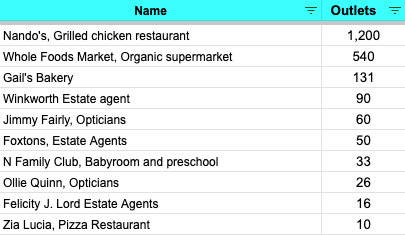
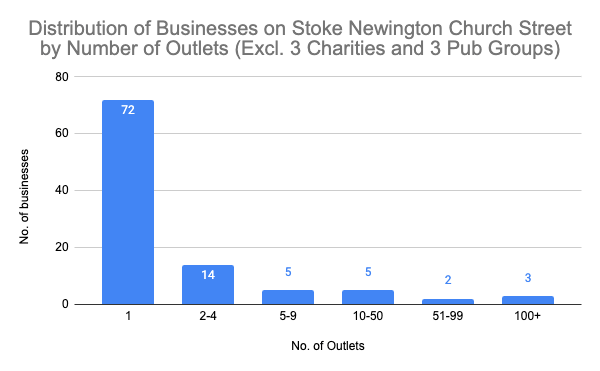
Excluding the three charities and three pub groups makes only an insignificant change to the overall outcomes. The total number of entities decreases from 107 to 101, and the slight shifts in percentage are almost entirely due to the smaller total rather than any substantive change in distribution.
- Those with 2-4 outlets decrease from 14% to 13%.
- Businesses with 5-9 outlets drop from 6% to 5%.
- Those with 10-50 outlets decrease from 7% to 5%.
- Businesses with 51-99 outlets decrease from 3% to 2%.
- The percentage of businesses with 100+ outlets decreases from 4% to 3%.
Conclusion
This analysis sheds light on the diverse types of entities operating on Stoke Newington Church Street, from small independent businesses to larger organisations with multiple locations. It’s fascinating to see how businesses in the area vary in size, structure, and reach. It also provides context for discussions about the growth of independent businesses and the increasing presence of larger organisations in local communities.
While it would have been extremely interesting to have a historical analysis and see how the numbers have changed over the years, obtaining data for every business that ever operated on the street would be nearly impossible. However, this snapshot serves as a useful starting point for understanding the current business landscape on Church Street.
If you have any additional insights or notice any discrepancies in the data, please feel free to reach out, and I’ll be happy to update the information accordingly.
 Stoke Newington History