
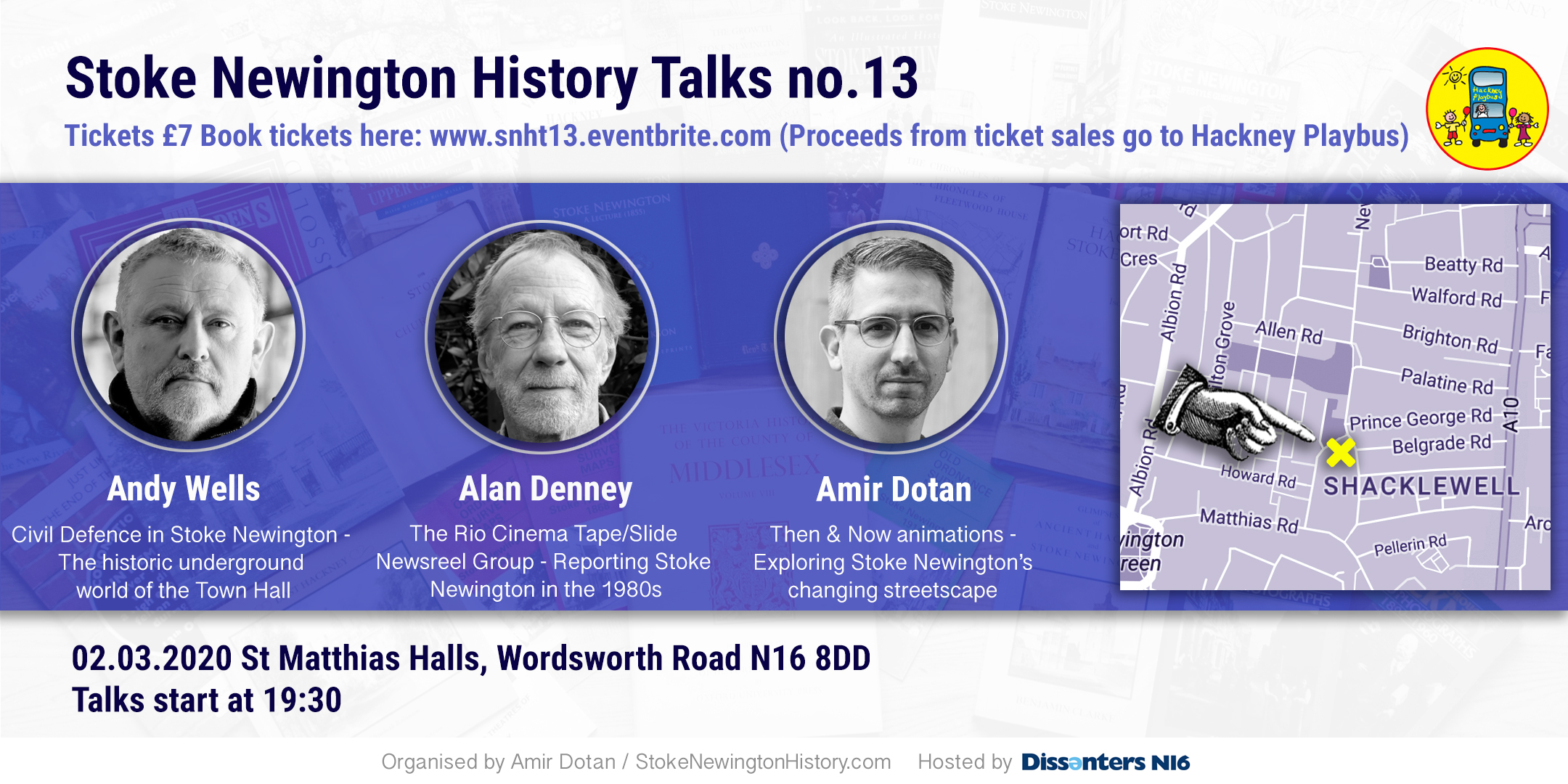
The 13th Stoke Newington History Talks event was held in St Matthias Halls on March 2nd in front of a packed audience. Brilliant talks by Alan Denney and Andy Wells. Proceeds from this event were donated to Hackney Playbus. Thank you to all who attended.
Here are the audio slideshows and slides of the three talks:
Then & Now animations – Exploring Stoke Newington’s changing streetscape by Amir Dotan
Recording
Summary
In this presentation Amir Dotan explores the changing streetscape of Stoke Newington by using “then and now” animated GIFs to blend historical photographs with modern-day views. This method allows viewers to see how buildings and landscapes have evolved over time, revealing layers of local history that are often overlooked.
Key areas and historical insights discussed include:
- Church Street & High Street: Dotan showcases the evolution of various buildings, including the transformation of pubs like the Horse and Groom (now The Auld Shillelagh) (1:27) and the shifting character of the high street over the decades (1:49, 14:54, 17:44).
- Demolished Mansions: The presentation highlights grand historical estates that no longer exist, such as Abney House (3:30) and Fleetwood House (3:59), noting that while the buildings are gone, original features like iron gates often remain (3:44, 10:19).
- Cinemas and Entertainment: Dotan discusses the lost cinemas of the area, including the Alexandra Theatre (5:47) and the Coliseum (6:57), contrasting their former grandeur or community role with their current repurposed states.
- Landscape & Infrastructure: He tracks the history of the New River (12:15, 13:21), the removal of historical bridges like Paradise Bridge (13:39, 14:04), and the massive reduction in the number of local pubs and independent shops over the last century (16:04, 16:44).
The Rio Cinema Tape/Slide Newsreel Group – Reporting Stoke Newington in the 1980s by Alan Denney
Recording
Summary
This presentation explores the history of the Rio Cinema Tape/Slide Newsreel Group, a project that operated in Hackney, London, between 1983 and 1988. Led by tutor Sandra Hooper, the group of unemployed teenagers used photography and audio to document local and national social issues of the mid-1980s.
Key themes and events covered by the group:
- The death of Colin Roach (0:51-8:00): One of the most significant stories, covering the suspicious death of a young Black man at the Stoke Newington police station and the subsequent community-led campaign for a public inquiry.
- Housing and redevelopment (8:31-11:15): The group documented the realities of poor housing conditions, squatting, and the demolition of Albert Town to make way for Butterfield Green.
- The Miners’ Strike (11:18-12:35): Coverage of the 1984–85 strike, including the twinning of Hackney with the Welsh mining village of Oakdale and the distribution of food aid.
- Immigration and deportation cases (12:37-14:15): Reporting on local families, such as the Hasbudak family, facing deportation by the Home Office.
- Community life (14:38-16:15): The archive also captures lighter moments of 1980s Stoke Newington life, including street festivals and celebrations like “Funk the Wedding” during the marriage of Prince Charles and Princess Diana.
Legacy and Archives:
After 30 years of lying dormant in the cinema’s cellar, the collection of approximately 12,000 slides was rediscovered. Alan Denney explains the process of scanning and cleaning these images, which are now being shared via the Rio Cinema Archive Instagram and are destined for the Hackney Archive to preserve this vital piece of local history.
Slides
Civil Defence in Stoke Newington – The historic underground world of the Town Hall by Andy Wells
Recording
Summary
In this presentation, Andy Wells from the Civil Protection Service explores the history and infrastructure of the Stoke Newington Town Hall, specifically focusing on its role in civil defense from the late 1930s through the Cold War.
Historical Context
- WWII Origins: The Town Hall served as an Air Raid Precautions (ARP) center from 1938 to 1945. You can still see original WWII camouflage paint on the upper windows (1:37-2:00).
- Cold War Bunker: In 1953, a nuclear bunker was constructed beneath the Town Hall to serve as a command and control center. It remained active until 1968, though the building continues to be used today for modern emergency planning and support (0:34-1:18).
The Nuclear Bunker
The bunker is a remarkably well-preserved ten-room facility. Andy Wells provides a detailed look at its layout and surviving equipment:
- Communications & Command: The bunker contains a phonogram room (7:44), a controller and information room (9:23), and a voice procedure room (14:06) equipped with vintage GPO equipment and acoustic hoods.
- Life Support: Unlike many bunkers of the era that used chemical toilets, this facility benefited from deep sewer lines, allowing for functional flushing toilets (13:17-13:36). It also features a generator room with an original Lister generator for power (18:08-19:20).
- Bunk Beds: The facility includes sleeping areas, with bunk beds salvaged from WWII deep-level shelters (21:04, 22:32).
Notable Features
- Ventilation: The bunker utilized a positive pressure system to keep contaminants out, with air intake and exhaust managed through external stacks (7:24, 19:48-20:25).
- Safety Measures: The site included escape hatches for emergency egress (4:56, 9:40, 23:02), though Andy Wells jokingly notes these areas are now inhabited by spiders (4:39, 9:51).
- Modern Legacy: While the bunker is no longer in use, Wells highlights the continuity of the Civil Protection Service, which still performs monthly communication tests similar to those conducted in 1968 (15:13).
 Stoke Newington History